Furniture Spacing and Clearance Sizes
Furniture clearance guide: sofa-to-table and walkway planning ranges in inches and cm, a worked measuring example, and accessibility limits.
Furniture clearance: planning, not code certification
| Clearance | Recommended | Minimum |
|---|---|---|
| Main traffic route | Plan a continuous, unobstructed route | Check applicable local requirements |
| Walkway beyond a coffee table | 30–36 in / about 76–91 cm (planning range) | Not a universal minimum |
| Sofa to coffee table | 14–18 in / about 36–46 cm (planning range) | Test sitting and standing with your furniture |
| Dining chair pull-out | Measure with the chair occupied and pulled out | No universal value stated here |
| TV viewing position | Use the display manufacturer's setup guidance | Not a furniture-clearance minimum |
The two numeric planning ranges are attributed in the living-room section. They are not building-code, accessibility or safety certification; dining and TV guidance must match the actual setup.
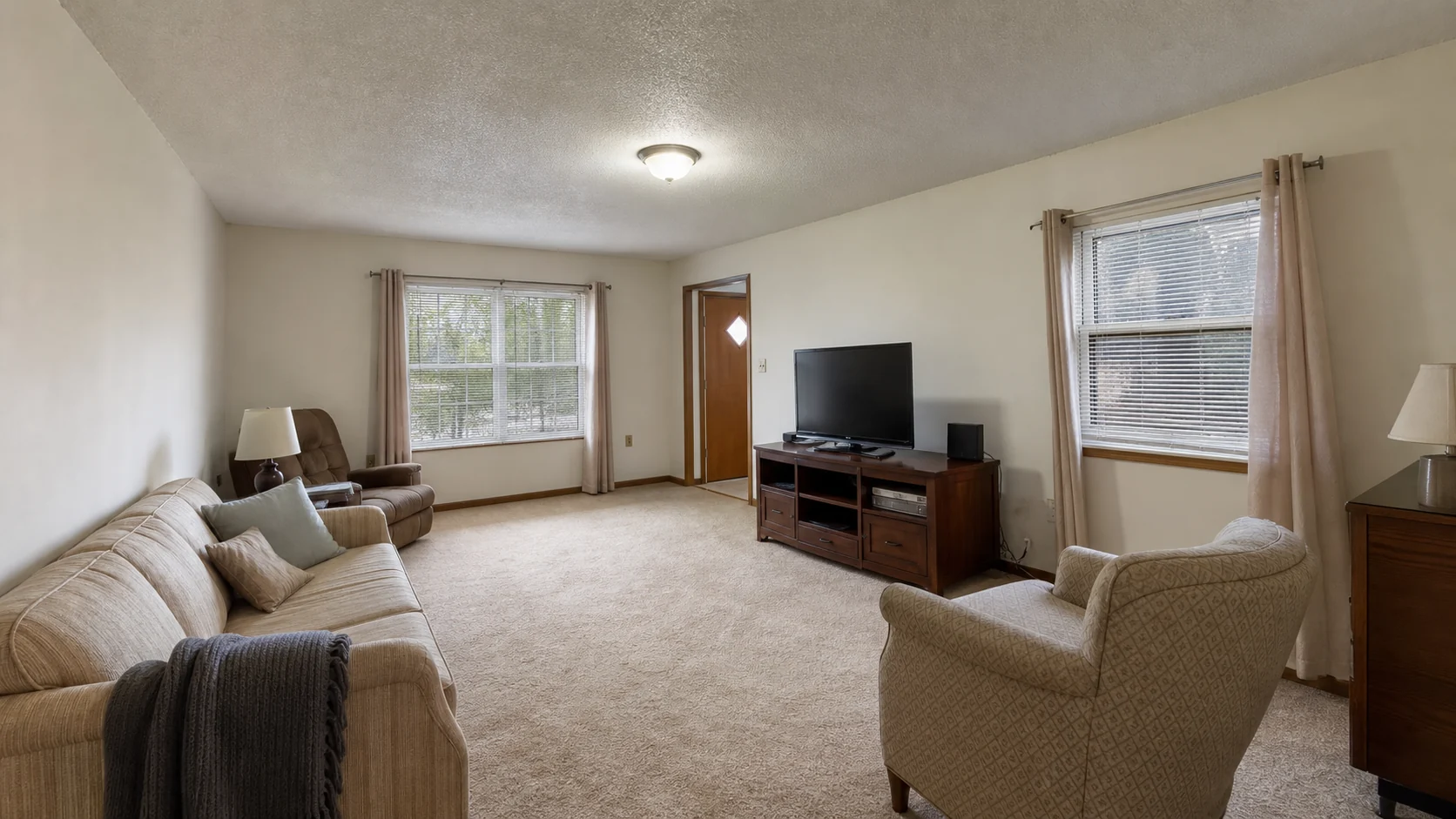
A sofa can fit against a wall and still block the route through a room. Before buying or moving furniture, measure the gaps people actually use: getting up from a seat, passing a table, opening a drawer and leaving the room.
This guide separates planning suggestions from requirements that apply to a particular building or accessible route. An AI room image can help you compare arrangements, but it cannot verify dimensions, access or code compliance.
Living room spacing: measure two different gaps
The space from a sofa to a coffee table is for seated legroom and reaching the table. The space beyond the table may be a walking route. Do not substitute one measurement for the other.
Will It Fit? Home’s sofa-to-coffee-table guide suggests 14–18 inches for the first gap and 30–36 inches for a walkway on the far side. Converted and rounded to whole centimetres, these are about 36–46 cm and 76–91 cm. These are that guide’s planning ranges, not universal minimums or building-code approval.
Try the arrangement with the seats and table you will use. Check whether you can sit, stand and reach the table without a corner obstructing your movement. Include projecting arms, feet and handles when measuring. A deeper seat or a different mobility need may require a different arrangement.
Worked measuring example — hypothetical, not a room inspection
Suppose your tape measure shows 16 inches (about 41 cm) between the sofa’s front edge and the nearest coffee-table edge. You then measure 32 inches (about 81 cm) between the table’s far edge and the media unit.
Those two measurements fall inside the planning ranges cited above. That does not establish that the room is accessible, meets local rules or works for everyone who will use it.
- Measure the clear horizontal distance between the nearest projecting edges, not the furniture centre lines.
- Record the sofa-to-table gap separately from the route beyond the table.
- Repeat with doors and drawers open and chairs in use; an empty-room measurement can hide an obstruction.
- Walk the intended route and check how each person sits and stands. If it needs to serve as a regulated accessible or exit route, have the applicable requirements checked before relying on the layout.
Dining room spacing
Measure with the actual chairs, not just the table footprint. Pull a chair out as you would to sit down, then check the space behind an occupied chair if that is also a walking route.
This guide does not give a universal dining-chair minimum or attribute a generic dining clearance to NKBA. Table shape, chair depth, who uses the room and any applicable access or exit requirements affect what must be checked.
Before buying, mark the table and chair footprints on the floor. Check the nearby door swing and the route to the kitchen. For a pendant or other fixture, follow its installation instructions rather than using a furniture-spacing rule as an electrical or head-clearance specification.
Bedroom spacing
Keep the route from the door to the bed clear, and check bedside access for the people who use it. Open dresser drawers and wardrobe doors fully before deciding that a gap is usable.
A nightstand should be reachable from the actual mattress position. Try the lamp, phone and drawer from the bed rather than treating a generic height difference as a requirement. Leave any manufacturer-required clearance for vents, radiators and other equipment.
Rug sizing
Use the furniture arrangement to choose a rug, not a fixed rug size for every room. Mark the candidate rug outline on the floor first.
| Room | What to test |
|---|---|
| Living room | Whether the chosen seating legs sit securely on the rug and its edge creates no awkward transition in the route |
| Dining room | Whether chair legs stay stable when a chair is pulled out and occupied |
| Bedroom | Whether the rug position works with bedside access and the door swing |
| Hallway | Whether the runner stays secure and does not obstruct doors or the usable route |
Follow the rug and underlay instructions for the floor surface. A larger rug is not automatically a safer or better-fitting arrangement.
TV viewing position
Viewing comfort is a different question from walkway clearance. Check the display manufacturer’s guidance for the model, screen size and setup, then try the viewing position without blocking the room’s route.
This page does not derive a screen-diagonal multiplier from THX or SMPTE reference-viewing standards. A viewing-distance suggestion should not be presented as a furniture safety minimum.
Accessibility and local requirements
For covered US accessible routes, section 403.5.1 of the 2010 ADA Standards generally specifies a 36-inch (915 mm) clear walking-surface width, with exceptions and separate provisions for turns and passing spaces.
That is a scoped US accessibility requirement, not a rule for every home or every country. Width alone does not establish compliance. Doors, manoeuvring space, changes in level and the applicable building requirements also need consideration. Use the relevant local authority or a qualified accessibility/building professional when those requirements apply.
In a small or open-plan room, preserve the required routes before choosing furniture sizes. Do not assume a smaller room permits ignoring access or exit requirements.
Frequently asked questions
How much space should be between a sofa and a coffee table?
The cited planning guide suggests 14–18 inches, about 36–46 cm. Use it as a starting point, then test sitting, standing and reach with the actual sofa and table. It is not a universal minimum.
What is the minimum walkway width in a room?
There is no single minimum stated here for every room. The 30–36 inch range above is third-party planning guidance for the space beyond a coffee table. Applicable accessible and exit-route requirements must be checked separately.
How much clearance do dining chairs need?
Check the actual chair while it is pulled out and occupied, plus any route behind it. Do not rely on an unverified generic minimum in place of the furniture dimensions and applicable requirements.
What size rug goes under a living room sofa?
Mark out the candidate rug and test it with your seating arrangement. Check leg placement, door swings and the walking route rather than assuming one standard rug size will fit.
How far should a TV be from the seating?
Start with the manufacturer’s instructions for the display and test the viewing position. Keep that decision separate from the clear route people need around the furniture.
Where to apply these checks
Start with the room’s routes, position the largest pieces, then measure the remaining gaps. For related planning topics, see the bedroom layout dimensions guide and the living room furniture layout rules.
To compare how an arrangement might look, open the Studio with a room photo. Treat the generated image as a design direction; verify the dimensions and requirements in the real room before buying or rearranging furniture.
Sources checked on September 20, 2026. The linked planning guide supports the two living-room ranges; the ADA source applies only within its stated scope. Neither validates every possible furniture layout.
Test the direction on your own room
The guest path creates one public, watermarked 1K preview after explicit consent. Sign in and use Credits when the room needs to stay private or you want to refine versions.
Open Studio