Interior Color Palette Ratios Guide
How to build an interior color palette: the 60-30-10 rule, undertones, LRV for paint, and room-by-room palette ratios with concrete percentages.
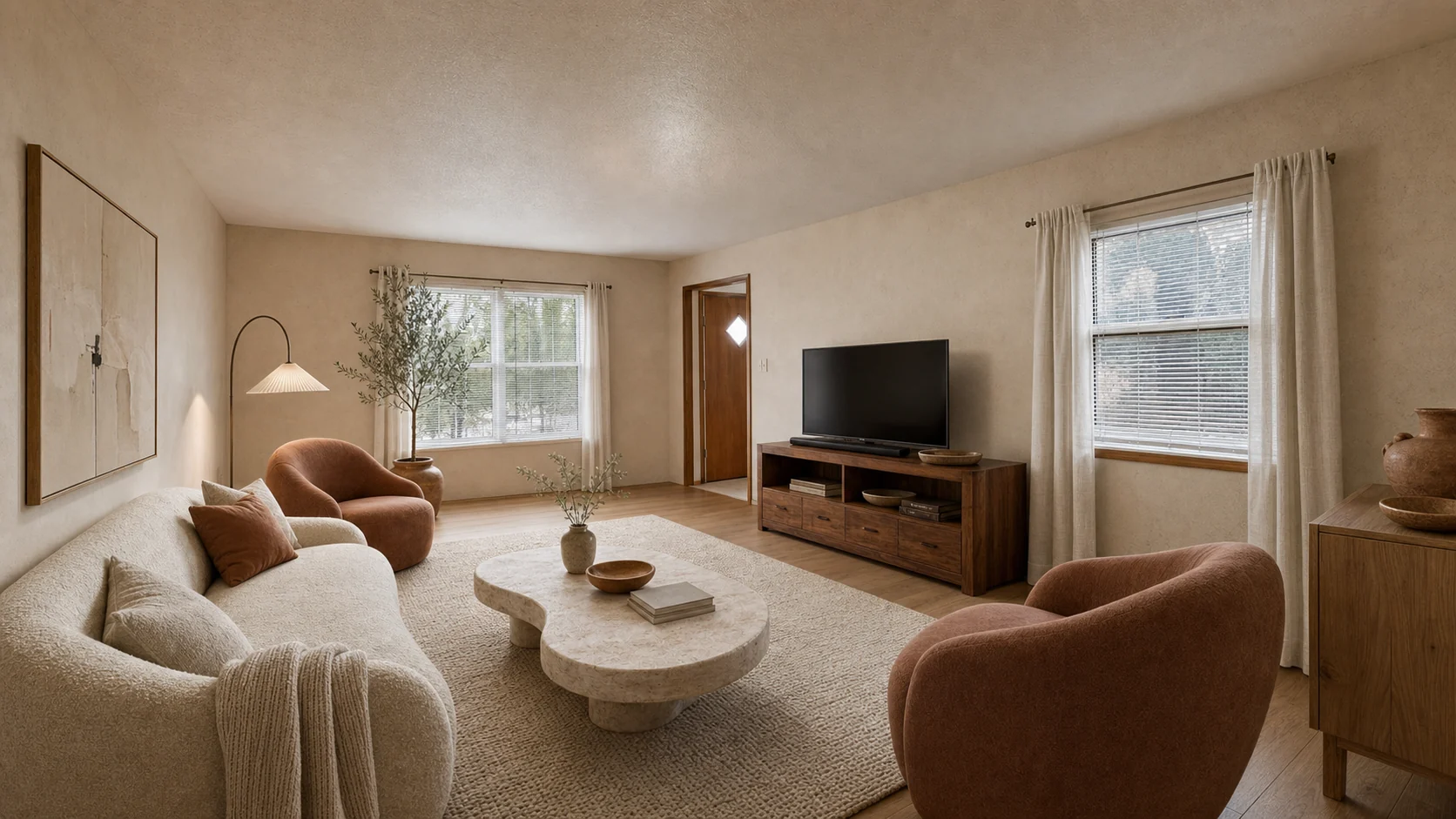
A room reads as “designed” when its colors follow a ratio, and “random” when they do not. The single most useful tool for getting there is the 60-30-10 rule, but it only works once you also understand undertones and how light a color actually is. This page gives the ratios, the percentages, and the technical measures professionals use to choose paint, so you can build a palette that holds together instead of guessing one swatch at a time.
Every recommendation here is a concrete number or a checkable rule. Use it to plan a scheme or to evaluate a palette an AI render hands you.
The short answer: the 60-30-10 rule
A balanced room divides its color into three roles by area. Get the proportions right and almost any three colors will feel cohesive.
| Role | Share of the room | Typically applied to |
|---|---|---|
| Dominant | 60% | Walls, large rugs, the biggest furniture |
| Secondary | 30% | Upholstery, curtains, an accent wall, bedding |
| Accent | 10% | Pillows, art, lamps, small decor |
The dominant color is the room’s mood. The secondary color supports it and creates contrast. The accent is the small dose of energy that keeps the room from feeling flat. Push the accent past 10 percent and the room starts to feel busy.
Extending the ratio
The basic three-part split scales up for richer schemes without losing balance.
- 60-30-10-10: split the accent into two complementary pops, each at about 5 percent, when you want a slightly more layered look.
- Neutral-forward rooms: keep the dominant and secondary in the same neutral family (for example greige walls and oatmeal upholstery) and let the 10 percent accent carry all the color.
- Bold rooms: a saturated dominant works, but it raises the stakes on the other two roles. Keep the secondary calmer and the accent disciplined or the room tips into chaos.
Undertones decide whether colors agree
Two grays can clash badly if one is warm and one is cool. Undertone, not the main hue, is what makes a palette feel intentional or muddy.
- Warm undertones lean yellow, red, or brown. Warm whites and greiges feel cozy and forgiving in low light.
- Cool undertones lean blue, green, or violet. Cool whites and grays feel crisp and clean but can read sterile in north-facing rooms.
- Test against a true white card. Hold a paint chip next to a pure white sheet and the undertone reveals itself: the chip will look slightly pink, green, blue, or yellow by comparison.
- Keep undertones consistent. A warm wall with cool-gray upholstery and a warm wood floor is the classic source of a palette that “almost works” but feels off.
Light reflectance value (LRV) for paint
LRV is the measure paint manufacturers print on every chip, from 0 (absolute black) to 100 (pure white). It predicts how light or dark a color will actually feel on a wall, which is often a surprise compared to a tiny swatch.
| LRV range | Reads as | Best use |
|---|---|---|
| 80-100 | Very light, bright | Small or dark rooms, ceilings |
| 60-79 | Light | Most main living spaces |
| 40-59 | Mid-tone | Accent walls, cozy rooms with good light |
| 20-39 | Dark | Moody rooms, feature walls, ample daylight |
| 0-19 | Very dark | Drama, small accents, rooms you can keep dim |
A practical rule: in a room with limited natural light, stay above an LRV of about 60 for the dominant color, or the space will feel smaller and gloomier than the swatch suggested.
Room-by-room palette ratios
The 60-30-10 split holds everywhere, but the choice of dominant shifts with how the room is used.
- Living room: a warm or neutral mid-light dominant (LRV 60-75) keeps it inviting through the day; carry the accent into pillows and art so it can change with seasons.
- Bedroom: lean toward a calmer dominant, often a soft, slightly desaturated color, and keep the accent low-energy. Sleep spaces benefit from less contrast.
- Kitchen and dining: higher contrast tolerates well here because the rooms are active; a darker secondary on cabinetry against a light dominant is a common, durable scheme.
- Home office: a cool-leaning dominant can aid focus, but balance it with a warm accent so the room does not feel clinical.
- Small rooms and hallways: favor a high-LRV dominant and a single restrained accent; busy palettes shrink small spaces visually.
When the rules do not fit
Color rules are guidance, and a few situations bend them.
- Open-plan spaces: the 60-30-10 ratio should hold across the whole connected area, not restart in each zone, or the open space reads as a patchwork. Keep one dominant and let secondaries shift subtly.
- North-facing rooms: cool colors and low-LRV paints get colder and darker in north light. Warm the undertone or raise the LRV to compensate.
- Rooms you cannot repaint: when the dominant color is fixed (rentals, existing tile or cabinetry), treat it as the 60 percent and build the 30 and 10 percent around its undertone rather than fighting it.
- AI-generated palettes: generated renders often produce gorgeous but unbuildable color combinations, or apply an accent across half the room. Translate any generated scheme back into the 60-30-10 split and check the undertones before adopting it.
Frequently asked questions
What is the 60-30-10 rule in interior design? It splits a room’s color into three roles: 60 percent dominant (walls and large pieces), 30 percent secondary (upholstery, curtains), and 10 percent accent (pillows, art, decor). Following the proportions makes almost any three colors feel cohesive.
How do I find a paint color’s undertone? Hold the chip next to a sheet of pure white paper. Against true white, the undertone shows itself: the color will look slightly warm (yellow, red) or cool (blue, green, violet) by comparison.
What LRV should I use for a dark room? Stay above an LRV of about 60 for the main walls in a room with limited natural light. Lower LRVs absorb light and make a dim room feel smaller and darker than the swatch implied.
Can I use more than three colors in a room? Yes. A common extension is 60-30-10-10, splitting the accent into two small pops of about 5 percent each. The key is keeping the dominant and secondary proportions intact so the room stays anchored.
Why do my room colors look off even though I like each one? Almost always an undertone clash. A warm color next to a cool one in the same role (for example a warm wall with cool-gray upholstery) reads as muddy. Aligning undertones usually fixes it.
Putting a palette together
Pick the dominant first and check its LRV against the room’s light, choose a secondary in a matching undertone, then add a single disciplined accent at 10 percent. Most palettes that “almost work” are fixed by aligning undertones, not by adding more color.
For the layout side of a room scheme, see the living room furniture layout rules and the furniture spacing and clearance guide. To test a palette on your own room before committing to paint, open the Studio.
Test the direction on your own room
The guest path creates one public, watermarked 1K preview after explicit consent. Sign in and use Credits when the room needs to stay private or you want to refine versions.
Open Studio